
Most chartplotter reviews come from someone who switched a unit on at a boat show. This one comes from the people who fit them.
The questions boat owners actually ask us are rarely about menu speed. They want to know if their current transducer will still work, what the wiring involves, and whether the upgrade makes sense on the boat they already own.
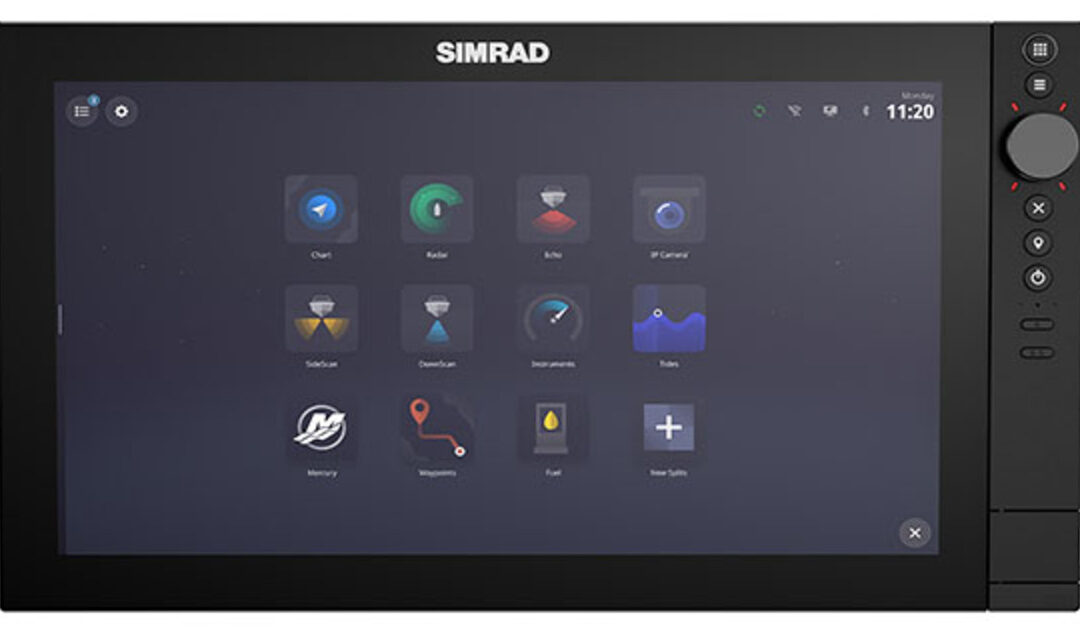
The NSS 4 is Simrad’s top-end display, sitting above the NSX range and replacing the older evo3S. It comes in three sizes and brings a faster processor and a new set of controls.
Here’s what’s good, what the spec sheet leaves out, and who should actually buy one.
Key Takeaways
- Available in 10, 12 and 16 inch sizes, all with the same screen resolution and brightness
- The 10 inch model misses out on the shortcut buttons fitted to the larger two
- Built-in sonar on the sonar models, and it can show four sonar views at once
- Display prices run from $2,599 to $6,199 depending on size and what’s included
- The display is often only about half the final cost once transducers, cabling and fitting are added
What’s New
It’s noticeably faster
The NSS 4 runs a Qualcomm 8-core processor. You notice it most when scrolling across a detailed chart or switching between screens. Older units stutter doing this. The NSS 4 doesn’t.
The controls changed
You now get a touchscreen, a rotary dial and a keypad on the same unit. That sounds like a small thing until you’re offshore in a chop with wet hands. Touchscreens are great at the dock and frustrating underway, so having a dial to fall back on genuinely helps.
One catch before you pick a size
The shortcut buttons are only on the 12 and 16 inch models. The 10 inch doesn’t get them. If you like jumping straight to a particular screen, that narrows your choice.
The screen is the same across all three sizes: 1280 x 800, over 1200 nits of brightness, and readable through polarized sunglasses. It’s rated for washdown and brief immersion, runs on 12 or 24 volts, and draws very little power.
Sonar
The sonar models have a built-in dual-channel 1kW CHIRP sounder, plus DownScan and SideScan imaging.
The standout feature is that it can show up to four sonar views at the same time. If you run more than one transducer, say a transom unit and a through-hull, you can see both at once instead of switching back and forth.
There’s also a neat addition called Waypoint Fish Tagging. You can tag a saved spot with a fish icon, which makes a season’s worth of marks far easier to make sense of later.
One important warning
The cheaper models without built-in sonar can’t be upgraded just by adding a transducer. They need a separate sonar box or another Simrad display sharing sonar across the network. People get caught by this, and it’s an expensive thing to find out after buying.
NSS 4 vs the Older evo3S
| NSS evo3S | NSS 4 | |
| Sizes | 9″, 12″, 16″ | 10″, 12″, 16″ |
| Speed | Previous generation | Qualcomm 8-core, noticeably faster |
| Screen | SolarMAX IPS | SolarMax IPS, over 1200 nits |
| Controls | Touch and keypad | Touch, dial and keypad |
| Sonar | 1kW CHIRP | Dual-channel 1kW CHIRP, up to 4 views at once |
| Charts | C-MAP, Navionics, CMOR | C-MAP X-Gen, C-MAP, CMOR, Standard Mapping |
| Works with | FLIR, CZone | Mercury SmartCraft, SiriusXM, CZone, FLIR, RGBW lighting |
So is it worth upgrading?
If your evo3S is working fine, probably not. The NSS 4 is faster and nicer to use, but neither of those will change how you use the boat.
The upgrade makes sense in three cases. You’re on older pre-evo3 gear. You want multiple sonar views at once. Or you’re building a wider Simrad system with radar, autopilot or networked sonar. Swapping out a healthy evo3S just for the interface is hard to justify at these prices.
What It Costs
Prices checked against Defender in October 2026. Retail prices move, so treat these as a guide.
| Model | What’s included | Price |
| 10 inch | No sonar, no charts | $2,599 |
| 10 inch | Sonar and C-MAP charts | $3,199 |
| 12 inch | No sonar, no charts | $3,799 |
| 16 inch | No sonar, no charts | $5,799 |
| 16 inch | Sonar and C-MAP charts | $6,199 |
For comparison, Simrad’s published prices for the outgoing evo3S were $2,399 for the 9 inch, $3,699 for the 12 inch and $5,499 for the 16 inch, all without a transducer. So the NSS 4 isn’t a big jump at equivalent sizes.
What those prices don’t cover. A transducer suited to your hull. Network cabling. A GPS aerial if you need one. And the labor to fit it all properly. On a typical retrofit, the display itself is often a little over half the finished bill.
What’s Involved in Fitting One
This is the part that decides whether you’re still happy with the unit in two years.
The transducer matters more than the screen
The display can only show what the transducer sends it. A great screen fed by a poorly chosen or badly placed transducer gives disappointing results, and owners nearly always blame the electronics. Your hull shape, your usual cruising speed and the depths you fish all affect which transducer is right.
Network wiring is where most retrofits go wrong
The NSS 4 connects to the boat’s data network through a single port, and that network needs setting up correctly. It has to be properly closed off at both ends, with the right cables and a sensible power point. Adding a connection without closing the network off properly is the single most common fault we find on systems someone else put together.
Power
The unit draws very little, but it still needs its own protected circuit rather than being wired into whatever was closest. It has built-in protection against wiring mistakes, which helps, but it’s no substitute for doing it properly.
Mounting
The 10 and 12 inch come with a bracket. The 16 inch doesn’t, so if you want it flush-mounted or in a pod, plan that before the unit arrives.
Setting it up
Sonar settings, autopilot calibration if you have one, loading charts, and a software update before handover. A unit that works on day one but never gets updated will start playing up within a season.
One last point. If the boat’s existing wiring is old or corroded, fitting new electronics to it just moves the problem rather than fixing it. Sometimes a rewire needs to come first.
Who Should Buy One
Good fit: Sportfishers who’ll genuinely use multiple sonar views. Anyone upgrading from pre-evo3 gear. Owners building a full Simrad system with radar, autopilot or networked sonar. Boats with Mercury engines, where the engine integration is useful.
Harder to justify: Owners with a perfectly good evo3S who mostly cruise and don’t fish hard. The improvements are real but small, and that money buys a lot of other things on most boats.
Pick your size carefully: The 10 inch saves money but loses the shortcut buttons. The 16 inch doesn’t include a bracket. Neither is a dealbreaker, but both are easier to plan for than to discover later.
Still choosing between brands rather than models? Our Simrad vs Garmin vs Furuno comparison covers that.
Common Questions
Can I keep my current transducer?
Often yes, if it’s a compatible 1kW unit in good shape and well positioned. Whether you should is another question. An older transducer will hold back what the new sonar can do.
Will it work with my Garmin or Raymarine gear?
Basic information sharing works across brands. Sonar, radar and charts don’t. Mixed-brand systems are possible but need planning rather than guesswork.
What does a full installation cost?
It depends on what’s already aboard. Swapping a display into a healthy existing system is straightforward. A full retrofit with transducer, cabling, radar and autopilot is a much bigger job. We quote after seeing the boat.
Is the 16 inch worth it over the 12?
Only if your helm has the room and you genuinely split the screen between several functions. A 16 inch showing one chart is money that could go elsewhere.
Do you service systems someone else installed?
Yes, and a fair share of our electronics work is exactly that. Most problems we find are wiring or network issues rather than faulty units.
Wrapping Up
The NSS 4 is a genuinely good display. The speed and the new controls are real improvements, not marketing.
It’s also expensive, and most of what decides whether you’re happy with it comes down to how it’s fitted rather than what you paid.
If you’re weighing up an upgrade and want a straight answer about whether it suits your boat, get in touch or request service. We’d rather tell you to keep what you’ve got than sell you something you don’t need.