
It always seems to happen at the worst time. You are two hours out of the marina on a July afternoon, the sun is hammering the deck, and the AC that was working fine last weekend is now blowing warm air. A quick look below confirms your fear; something is wrong, and you are not sure what.
Most marine AC problems are not sudden failures. They are the result of small maintenance tasks that got skipped over a season or two. The good news is that the majority of what keeps a marine AC system running reliably can be handled by the boat owner. You do not need to be an engineer, and you do not need to schedule a technician visit for every maintenance item.
This guide covers what to check, when to check it, and how to tell the difference between an owner task and a job for a professional. If you are not sure what shape your boat’s overall electrical system is in, it is also worth taking a look at how to check and test your boat’s battery system before heading into the hot season.
How Marine AC Differ From a Home AC System
Before getting into the maintenance tasks, it helps to understand one fundamental difference between marine and household air conditioning.
A home AC system rejects heat by pushing it out through a fan and an outdoor condenser unit. A marine AC system rejects heat by circulating seawater through a heat exchanger onboard the vessel.
That seawater circuit is the heart of a marine AC system, and it is also the source of most maintenance needs. Salt, sediment, marine growth, and scale all accumulate in the seawater side of the system over time. Ignore it long enough, and the heat exchanger fouls, the pump works harder, and eventually the system either overheats or fails entirely.
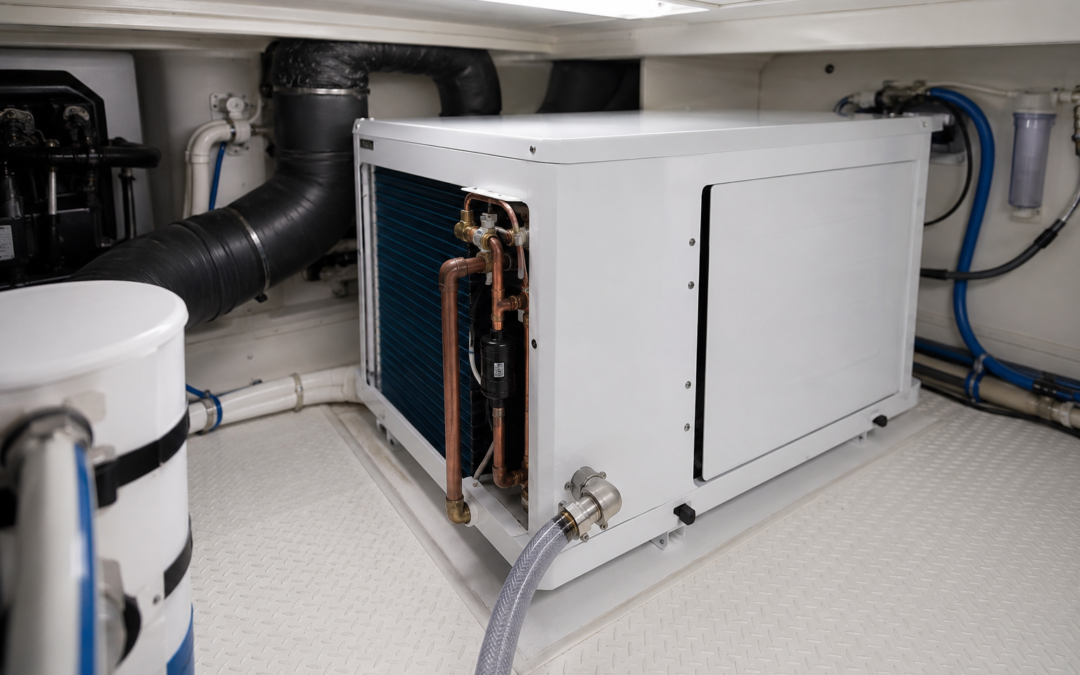
The main components to know are the seawater pump, which pulls water from outside the hull; the sea strainer, which filters debris before it reaches the pump; the heat exchanger, which transfers heat from the refrigerant into the seawater; the evaporator coil, which cools the air inside the cabin; and the air handler, which distributes that cooled air through the boat. Each of these has specific maintenance requirements.
How Often Should You Service A Marine AC
The short answer is more often than most boat owners do.
San Diego’s year-round boating climate means many systems run for eight to ten months of the year rather than the four or five months typical in seasonal markets. That additional runtime adds up.
A practical schedule looks like this:
- Before the summer season starts: Do a full inspection of every component.
- During active use: Check the sea strainer and air filter monthly.
- At the end of the season: To Flush the seawater circuit and do a full electrical inspection before leaving the system dormant.
Boats that see heavy use, liveaboards, charter vessels, and boats doing longer offshore passages should add a mid-season check to that schedule. If the system runs continuously for months at a time, quarterly inspections are reasonable.
Marine AC Maintenance Checklist
1. Clean or Replace the Sea Strainer
The sea strainer is the first line of defence for the entire seawater circuit. It sits between the through-hull fitting and the seawater pump, and its job is to catch debris, weed, sediment, shells, and small marine growth before it reaches the pump impeller.
Cleaning it is straightforward. Close the seawater seacock, remove the strainer basket, rinse it under fresh water, check for cracks or damage, and reinstall. The whole job takes less than ten minutes. How often you need to do it depends on where you moor. Boats at marinas with a lot of weed growth or silt may need weekly checks during heavy use, while cleaner anchorages can go monthly.
If the basket looks corroded or cracked, or is no longer sitting flush in its housing, replace it. A failed sea strainer basket can let debris reach the pump and cause an impeller failure, which is an expensive and avoidable repair.
2. Check and Clean the Seawater Pump
The seawater pump circulates water through the heat exchanger. The most common maintenance item is the impeller, a rubber component inside the pump that pushes water through the circuit. Impellers degrade over time, especially if the pump runs dry even briefly.
Signs of a failing impeller include reduced water flow from the overboard discharge, the AC unit running warmer than usual, or the pump making a laboured noise.
A visual inspection requires removing the pump cover, which most boat owners can do with basic tools. If the impeller shows cracks, broken vanes, or signs of melting, replace it. As a general rule, impellers should be inspected every season and replaced every one to two years, depending on hours of use. Keeping a spare impeller onboard is standard practice.
3. Inspect and Clean the Evaporator Coil and Air Filter
The air filter in a marine AC unit traps dust, salt particles, and moisture from the cabin air before it passes over the evaporator coil. A clogged filter reduces airflow, forces the unit to work harder, and can lead to ice forming on the coil.
Cleaning the filter is an owner task that takes two minutes. Remove it, rinse under fresh water, let it dry, and reinstall. How often depends on how dusty or salty the cabin environment is, but monthly during active use is a reasonable baseline.
The evaporator coil itself is more involved. Over time, mould and mildew build up on the coil, which reduces cooling efficiency and creates unpleasant odours in the cabin. A coil cleaning spray designed for marine AC units can handle light fouling. Significant mould growth or ice formation on the coil that persists after cleaning the filter points to a refrigerant or airflow problem that needs a technician.
4. Flush the Seawater Circuit
Scale and mineral deposits from seawater accumulate inside the heat exchanger and seawater hoses over time. In San Diego Bay, the combination of salt content and biological growth means this happens faster than many owners expect.
Flushing the seawater circuit with a descaling solution, typically a diluted acid solution designed for marine heat exchangers, removes this buildup and restores heat transfer efficiency. This is a once-a-season job, best done at the end of the boating season or before a prolonged period of storage.
Most marine supply stores stock descaling kits with clear instructions. The process involves temporarily disconnecting the seawater hoses, circulating the solution through the circuit with a small pump, then flushing with fresh water. If you have not flushed the circuit in more than two seasons, the job is overdue.
5. Check Refrigerant Levels
A low refrigerant charge is one of the more common reasons a marine AC system stops cooling effectively.
The signs are familiar: The unit runs, but the air coming out is barely cool, or you notice ice forming on the evaporator coil, which is a sign the system is running undercharged.
Refrigerant handling is a licensed technician task. Environmental regulations require anyone working with refrigerants to hold an EPA 608 certification, and attempting to add refrigerant without proper equipment will damage the system. If you suspect a low charge, the right call is to have a certified technician inspect the system, identify whether there is a leak, and recharge it correctly.
6. Inspect Electrical Connections and Wiring
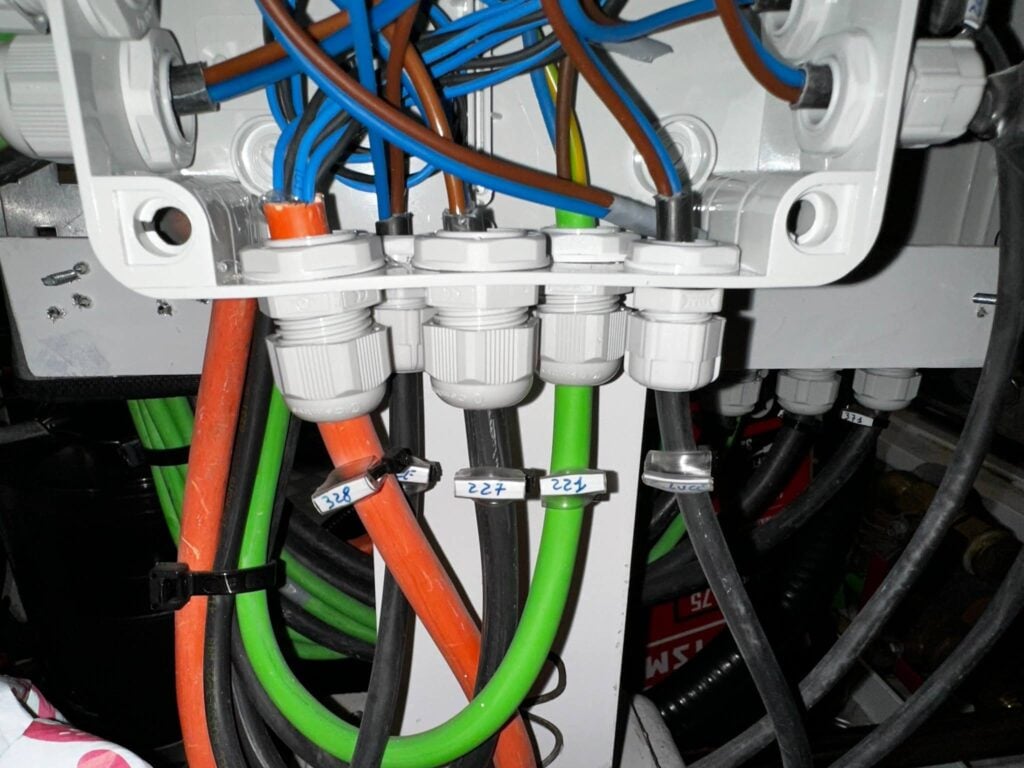
Saltwater environments are hard on electrical connections. Corrosion at the terminals feeding the AC compressor, air handler, and seawater pump is a common and often overlooked cause of system problems. A loose or corroded connection causes voltage drop, which makes the compressor work harder and shortens its lifespan.
At each inspection, check that all visible connections are clean, tight, and free of green or white corrosion. Dielectric grease applied to terminals after cleaning slows future corrosion significantly. If you find corrosion that has worked its way into the wire insulation or terminal block, that is a job for a technician.
Any significant electrical work on a marine AC system such as rewiring, panel connections, shore power integration, should be handled by an ABYC-certified marine electrician to ensure it meets safety standards and does not create issues elsewhere in the vessel’s electrical system.
7. Know What the Unusual Noises Mean
A healthy marine AC system should be relatively quiet. A steady hum from the compressor and a soft rush of air from the handler. Any change from that baseline is worth investigating.
A rattling or vibrating noise usually points to a loose panel, an unsecured hose, or a failing fan bearing. A grinding or squealing noise from the compressor or pump is more serious and typically means a mechanical failure is imminent. A burning smell
Signs You Need A professional for Your Marine AC
 Some problems are beyond owner-level maintenance. If any of the following are happening, call a technician rather than trying to troubleshoot further. You can always test your boat’s battery and electrical system as a first step, but the AC itself will need hands-on assessment.
- The system runs but produces no cooling despite clean filters and normal seawater flow
- The compressor cycles on and off rapidly which indicates a refrigerant, pressure, or electrical fault
- Water is leaking inside the cabin from the air handler or ductwork
- The system is tripping the circuit breaker repeatedly
- You hear a grinding or squealing noise from the compressor
- There is a burning smell from anywhere in the system
- The unit shows a fault code that does not clear after a basic reset
Catching these early makes the repair significantly cheaper. A compressor that is short-cycling and left running will eventually burn out, and marine compressors are expensive to replace.
Maintenance vs Repair: Whats the difference
There is a useful way to think about marine AC maintenance. Maintenance is what you do to prevent problems. Repair is what happens when maintenance is deferred long enough that something actually fails.
The tasks in this guide such as strainer cleaning, filter cleaning, impeller inspection, circuit flushing, connection checks are all maintenance. They take a few hours across the season, and they are almost all owner-level tasks. The repairs that follow from not doing them, compressor failure, heat exchanger fouling, pump seizure cost several times more and usually happen at the least convenient moment.
FAQs
How often should I service my marine AC?
At minimum, a full inspection before the summer season and monthly filter and strainer checks during active use. Year-round boaters in San Diego should add an end-of-season circuit flush and electrical inspection before any extended period of reduced use.
Why is my boat AC not cooling properly?
The most common causes are a blocked sea strainer restricting water flow, a fouled evaporator coil reducing heat transfer, a low refrigerant charge, or a failing seawater pump. Start by checking the sea strainer and air filter. Both are five-minute tasks. If those are clean and the problem persists, the system needs a technician to diagnose refrigerant or pump issues.
Can I service my marine AC myself?
Yes, for most of the routine tasks. Sea strainer cleaning, air filter cleaning, visual inspections, and end-of-season circuit flushing are all owner-level jobs. Refrigerant handling, compressor work, and any electrical faults require a licensed technician. Impeller replacement sits in the middle, mechanically straightforward for an experienced boat owner, but worth having a professional do the first time if you have not done it before.
How long does a marine AC system last?
A well-maintained system typically lasts ten to fifteen years. Neglected systems, particularly those that have never had the seawater circuit flushed or the impeller replaced, often fail within five to seven years. The single most common cause of early failure is the system running with a blocked sea strainer or fouled heat exchanger, which puts continuous strain on the compressor.
Conclusion
Most marine AC problems are avoidable. The maintenance tasks in this guide take a few hours across the course of a season and prevent the kind of failures that sideline a boat on the hottest weekend of the year.