
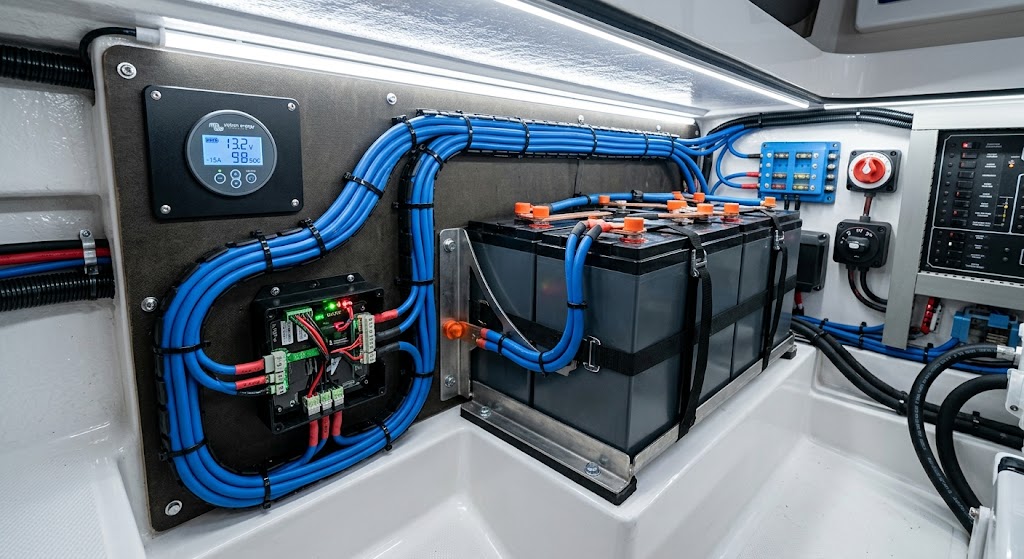
Lithium vs AGM Marine Batteries: Which Is Right for Your Boat?
If your battery bank no longer lasts through the night, your electronics are cutting out under load, or you are planning longer trips away from shore power, you have probably started looking at battery options. The decision usually comes down to two choices: stick with AGM or upgrade to lithium.
Both have real advantages. Both suit different boats and different budgets. This guide breaks down the key differences clearly, so you can make the right call for your vessel.
Not sure where your current battery bank stands? Start by reading our guide on how to check and test your boat’s battery system before deciding anything.
Quick Answer: AGM vs Lithium Marine Batteries
AGM is the better choice for simpler systems, tighter budgets, and boats that spend most of their time on shore power. If you need a straightforward replacement without touching your charger, wiring, or alternator setup, AGM works well.
Lithium is the better choice for heavier electrical loads, longer time off shore power, and owners who want fewer battery replacements over the long run. For cruising boats, liveaboards, and vessels running inverters or refrigeration, the performance gap is significant.
The right answer depends on how your boat is actually used.
What Are AGM Marine Batteries?
AGM stands for Absorbed Glass Mat. It is a type of sealed lead-acid battery in which the electrolyte is held in a fiberglass mat between the plates, rather than being a free liquid. This sealed design means no maintenance, no watering, and no acid spills, which is why AGM became the standard on boats over the past few decades.
AGM batteries are reliable, widely available, and compatible with most existing charging systems without any modifications. They are also significantly cheaper to buy upfront than lithium batteries, which makes them attractive for owners.
On the flip side, AGM batteries are heavy; a 100Ah AGM bank typically weighs 28 to 35 kilograms. They also have a safe usable capacity of around 50% of their rated size, meaning a 100Ah AGM bank delivers about 50Ah of usable energy before you risk damaging the cells.
What Are Lithium Marine Batteries?
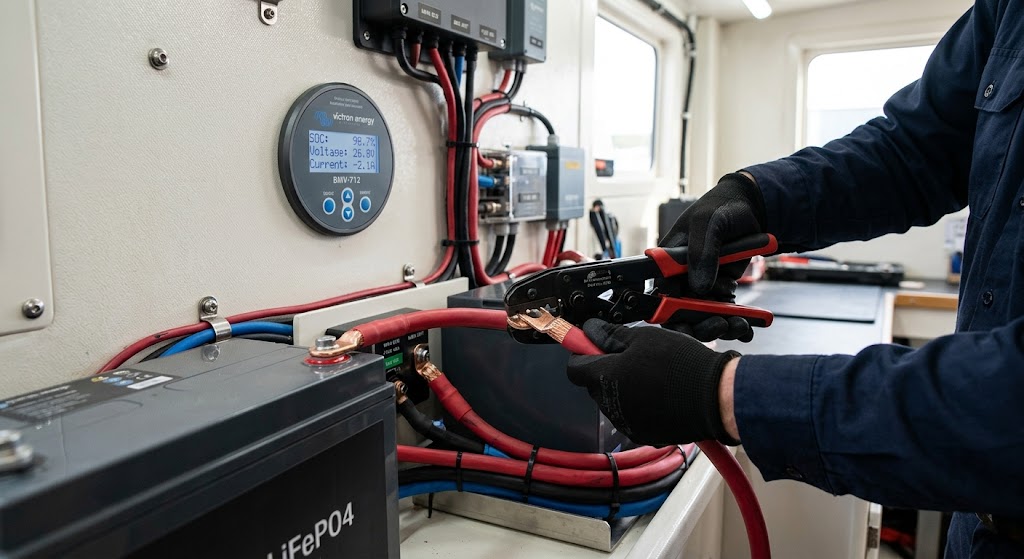
Lithium marine batteries use lithium iron phosphate (LiFePO4 in chemistry). This is the material used in quality marine lithium banks from brands like Victron, Lithionics, Battle Born, and others, chosen specifically because it is more thermally stable and safer than other lithiums.
The performance difference over AGM is substantial in a few key areas. A 100Ah lithium bank gives you access to 80 to 90% of that capacity safely, versus about 50% with AGM.
Lithium is also roughly 60% lighter for the same rated capacity, a meaningful advantage on larger boats with big house banks. And with a cycle life of 2,000 to 5,000 or more cycles when installed correctly, a lithium bank can outlast three or four AGM replacements.
The critical qualifier is correct installation. Lithium is not a drop-in replacement for AGM in most systems. Your charger, alternator protection, and wiring all need to match.
Lithium vs AGM Marine Batteries
Here is a side-by-side comparison across the factors that matter most to boat owners.
| Factor | AGM | Lithium (LiFePO4) |
| Upfront Cost | Lower ($150-$200 per 100Ah) | Higher ($600-$900 per 100Ah) |
| Usable Capacity | ~50% of rated capacity | ~80-90% of rated capacity |
| Weight (100Ah) | 28-35 kg | 13-15 kg |
| Cycle Life | 300-500 cycles | 2,000-5,000+ cycles |
| Typical Lifespan | 3-5 years under regular use | 8-15 years with correct install |
| Charging Speed | Slower | Faster (charger must be compatible) |
| Drop-In Ready | Yes | Usually not — system changes needed |
| 10-Year Cost | Higher (replacements needed) | Lower for heavy users |
When AGM Batteries Still Make Sense
AGM is not the outdated choice it is sometimes made out to be. For many boats and owners, it remains the right answer.
- Smaller boats with simple electrical systems and no inverter
- Boats that spend most of their time connected to shore power
- Starting batteries because AGM handles engine cranking well and is still the standard
- Budget-conscious replacements where a like-for-like swap is the priority
- Owners who do not want to modify their existing charging system
- Boats that are used occasionally rather than continuously
If your boat fits most of those descriptions, AGM is a solid, reliable choice. The additional complexity and upfront cost of lithium does not make sense for every application.
When a Lithium Upgrade Makes Sense
Lithium is the clear long-term choice when electrical demand is higher and time off shore power is longer.
- Cruising boats spending nights or weekends away from the dock
- Liveaboards running refrigeration, watermakers, and inverters daily
- Boats with solar charging systems as lithium accepts solar charge more efficiently
- Larger house banks where weight reduction makes a tangible difference
- Owners who want to eliminate the cycle of replacing AGM banks every few years
- Boats with high inverter loads, such as AC appliances, entertainment systems
If you have already replaced your AGM bank once and your usage pattern has not changed, that is a strong signal to consider lithium the next time. The cycle of replacing expensive AGM banks every three to four years under heavy use is exactly where lithium pays for itself.
If your current system is showing signs of age, read our guide on how to check your boat’s battery system and identify whether it is time to act.
Why Lithium Is Not Always a Drop-In Replacement
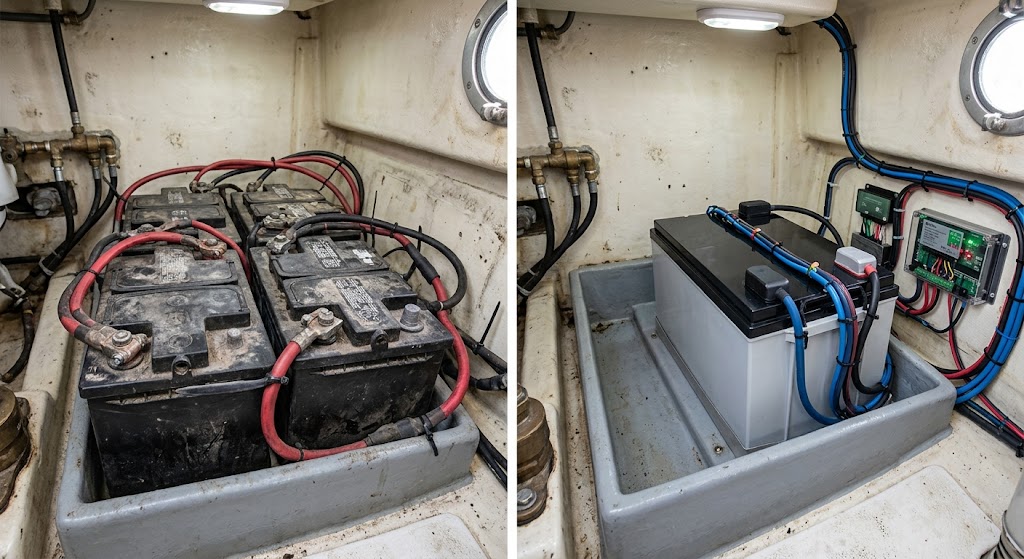
Lithium batteries have different voltage characteristics, charge requirements, and protection needs compared to AGM.
Treating a lithium upgrade as a simple battery swap, like pulling out the AGM and dropping in lithium with no other changes, can damage the cells, harm your alternator, or create a system that fails prematurely.
The key areas that need to be evaluated before installing lithium:
- Charger compatibility: AGM chargers often use absorption stages that are not correct for lithium. A lithium-compatible charger is required.
- Alternator protection: Lithium banks can demand charge current at a rate that overloads a standard marine alternator, particularly during heavy charging cycles. An alternator protection device or DC-DC charger is often needed.
- Battery management system: A BMS monitors cell voltage, temperature, and state of charge, and cuts off charging or discharging if parameters go out of range. Most quality lithium batteries include an integrated BMS, but it must be correctly wired.
- Wiring and fusing: Lithium can deliver and accept current at higher rates than AGM. Existing wiring may need to be upsized and fusing recalculated to match.
- Battery monitor: A shunt-based battery monitor is needed to accurately track state of charge, since lithium has a very flat discharge curve and voltage alone is not a reliable indicator.
This is the kind of work that needs to be done the first time correctly. An ABYC-certified marine electrician will evaluate your existing system, identify what needs updating, and install the new bank to the correct standards. Poor lithium installations are one of the most common reasons the technology gets a bad reputation.
Correct installation also matters for your vessel’s marine bonding system, which must remain intact and properly configured when any major electrical work is carried out.
Common Signs Your Boat May Need a Battery Upgrade
If any of these are familiar, your battery bank is likely failing or undersized for current demand:
- House batteries do not hold a charge through the night
- Engine cranks slowly, particularly when batteries are partially discharged
- Electronics such as chartplotter, VHF, instruments reset or shut off under load
- Voltage drops quickly when running appliances or the inverter
- Inverter trips under loads that it previously handled without issue
- Batteries are swollen, warm to the touch, or visibly corroded at the terminals
- The bank is five or more years old, and performance has noticeably declined
Two or more of these signs together are a clear indication that the system needs assessing. Continuing to run on a failing bank risks damage to sensitive electronics and leaves you exposed on the water.
Before making any decisions, it helps to test your boat batteries under load to get a clear picture of how much capacity actually remains.
Which Battery Is Right for Your Boat?
The honest answer depends on three things: how the boat is used, what the existing system looks like, and what budget is available for the upgrade.
Choose AGM if your boat has a basic electrical system, your power needs are modest, you spend most time on shore power, and you want a straightforward replacement without system changes. AGM is reliable, well understood, and still the right answer for a significant number of boats.
Choose lithium if your boat has significant house loads, you spend nights or longer away from shore power, you are running an inverter or refrigeration regularly, or you want to stop replacing batteries every few years. The higher upfront cost of lithium makes financial sense when the usage justifies it.
One important caution: Do not make the decision based on battery price alone. A lithium bank installed into a system that has not been properly evaluated for compatibility can underperform, fail early, or cause damage. A professional assessment before any upgrade is money well spent.
FAQs About Lithium vs AGM Boat Batteries
Are lithium boat batteries worth it?
For boats with heavy house loads, inverters, refrigeration, or long trips away from shore power, yes. The higher upfront cost is offset by longer lifespan, less frequent replacement, and significantly better usable capacity. For simple boats mostly on shore power, AGM may still be the more practical choice.
Can I replace AGM batteries with lithium?
In many cases yes, but not by simply swapping the batteries. The charger, alternator protection, wiring, fusing, and monitoring system usually need updating to suit lithium’s different requirements. An assessment by a certified marine electrician before any upgrade is the right first step.
Do lithium marine batteries charge faster than AGM?
Yes, lithium accepts a higher charge rate and recovers faster from partial states of charge. However, this only works correctly when the charging system is designed for lithium. Using an AGM charger on lithium will undercharge the bank and reduce its effective lifespan.
How long do lithium marine batteries last?
With correct installation and compatible charging, lithium marine batteries typically last 8 to 15 years and 2,000 to 5,000 cycles. That compares to 3 to 5 years for AGM under regular cycling use. The key qualifier is correct installation, a poorly set up lithium bank will not reach anywhere near that lifespan.
Is AGM still good for marine use?
Absolutely. AGM remains the right choice for starting batteries, simple house banks, budget-focused replacements, and boats where the electrical demands are modest. It is a proven, reliable technology. Lithium is not always the better answer; it depends entirely on how the boat is used.
Still Not Sure?
If you are not sure which direction makes sense for your specific boat, a system assessment is the logical first step. We can evaluate your current setup, advise on whether lithium is the right upgrade, and handle the installation from start to finish.
Contact us to get a quote from marina electrician in San Diego or to book a battery system assessment with Zisser Marine Service.