
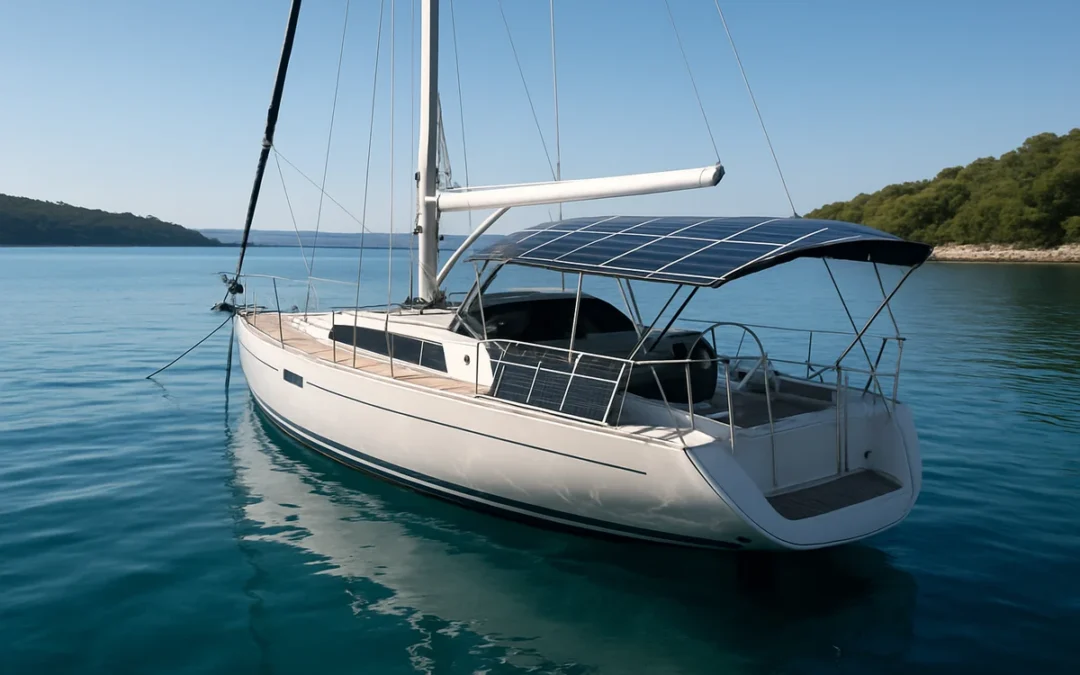
Marine Solar Explained: Sizing, Panels, and What Works on a Boat
Solar on boats used to be a hobbyist thing. A couple of panels bolted to a Bimini, mostly for topping off the batteries. That’s changed. Panels got cheaper, batteries got smarter, and a lot of boaters are just tired with generator noise.
Still, most boat owners get solar wrong. They buy panels first. They think about sizing later. That backwards approach wastes money.
This guide flips the order. You will learn how to size a system first. Then you will pick panels that fit your boat and your budget.
Key Takeaways
- Start with your daily power draw, not the panel on sale
- Monocrystalline panels give you the best output for the space
- Flexible panels flex to fit curves, but don’t last as long
- A charge controller keeps your batteries from cooking themselves
- Shade and heat will quietly wreck your output numbers
- Panels are half the system. Your battery bank is the other half
Stick with us through this, and you’ll walk away knowing what your boat actually needs, not what a sales page told you to buy.
Step 1: Know What You’re Actually Using
Skip this part and you’re just guessing at everything downstream. Don’t skip it.
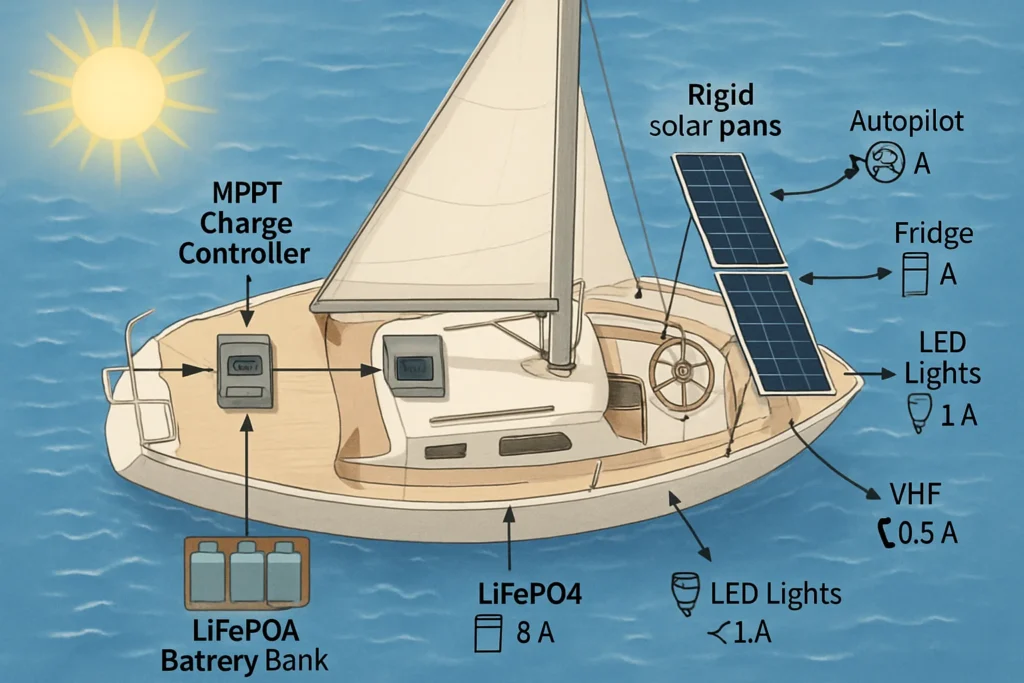
Walk Your Boat, Write It Down
Go compartment by compartment. Note every single thing that pulls power.
- Refrigerator
- Cabin and cockpit lights
- Freshwater pump
- Chart plotter
- VHF radio
- Phone and laptop chargers
- Fans, or AC if you run it
Most devices list their wattage right on a sticker. No sticker? Multiply the volts by the amps and you’ve got it.
Turn It into Watt-Hours
Take each device’s wattage and multiply by how long you run it each day. A 40-watt fridge running around the clock is 960 watt-hours a day, just by itself. A 10-watt reading light for four hours adds 40 more.
Small stuff adds up faster than people expect. Add every device together. That’s your real number.
Add a Buffer
Wiring loses a little power. Batteries lose a little more. Inverters aren’t perfect either. Add 20% on top of your total. That’s your buffer for the gray, rainy day where the sun barely shows up.
Step 2: Understand Solar Output Realities
Panel wattage on the box comes from a lab. Perfect light, perfect angle, cool temperature. Your boat gets none of that most days.
What Actually Eats Your Output
A few things quietly tank the numbers you were counting on.
- Clouds can cut your output by half or worse
- Shade from a sail, antenna, or outrigger blocks light completely
- Heat past 77°F starts dragging efficiency down
- A flat mount catches way less sun than a tilted one
- Salt film builds up over weeks if nobody’s rinsing the panels
A 100-watt panel might realistically give you 300 to 400 watt-hours a day. That number moves depending on where you are and what month it is.
Peak Sun Hours Matter
These aren’t the same thing. Daylight hours include every hour with any light at all. Peak sun hours only count the strong, direct stuff.
Most coastlines average 4 to 6 peak sun hours a day. Multiply that by your panel’s wattage, and you’ve got a rough daily estimate, before losses.
A 200-watt panel at 5 peak sun hours gives roughly 1,000 watt-hours. That’s the starting number, before wiring and battery losses take their cut.
Step 3: Size the System Correctly
Now you have two numbers. Your daily usage and your expected solar output.
Overshoot a Little
You want your solar setup producing a bit more than you burn through daily. That gap covers the cloudy days and the losses you can’t avoid.
Burning 1,000 watt-hours a day? Aim for 1,200 to 1,300 watt-hours of capacity. That extra margin is what saves you when the weather doesn’t cooperate.
Account for Battery Storage
Solar charges batteries. Batteries run your gear. If the battery bank is undersized, extra panel capacity just goes nowhere.
Lithium batteries hold more charge in a smaller footprint, and they outlast lead-acid by a wide margin. A lot of boaters are switching over for exactly that reason.
Getting your battery bank sized right alongside your solar array matters more than most people realize. Talk to us before you buy either one.
What Panel Actually Belongs on Your Boat
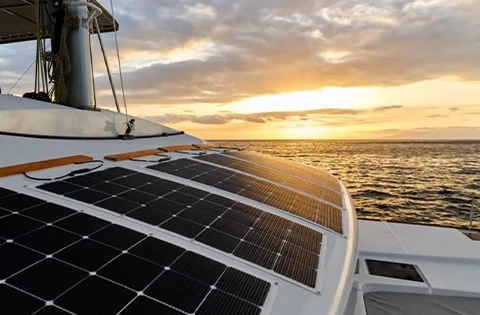
Different panels suit different boats. Here’s the honest breakdown.
Monocrystalline
Made from single-crystal silicon, these are the most efficient panels you can buy right now. They squeeze the most watts out of the least deck space, and they still pull decent power in hazy or overcast light. Expect them to last 20 to 25 years without much fuss.
The catch is price, they cost more up front, and rigid versions add real weight to your deck. Still, if you’ve got open flat space, this is usually the right call.
Polycrystalline
These use several silicon crystals fused together instead of one continuous crystal. Cheaper to make, cheaper to buy. In strong direct sun they hold their own just fine.
Where they fall short is cloudy weather, efficiency drops noticeably, and you’ll need more surface area to match what a monocrystalline panel does in less space. Once you account for that extra deck real estate, the savings often aren’t as big as they first look.
Flexible Panels
These bend, which is the whole point. Curved cabin tops, Bimini frames, spots where a rigid panel just won’t sit flat, flexible panels handle it. They’re light, low-profile, and some models you can even walk on without cracking them.
The trade-off shows up over time. Expect 5 to 10 years before they start losing capacity, not 20. They also run hotter than rigid panels, which quietly eats into efficiency, and they’re more prone to hairline cracks after a few seasons of flexing. Great option when space is tight. Just budget for replacing them sooner.
Rigid Panels
Framed in glass or aluminum and bolted to a bracket or arch, these last the longest of any type, often 20-plus years, and they shed heat better than flexible panels, which keeps efficiency higher across the board.
They’re heavier, and you’ll need solid mounting hardware to hold them in place. But if your boat already has an arch or davits, rigid is almost always the better long-term buy.
Charge Controllers: The Overlooked Component
Many boaters focus only on panels. But the charge controller matters just as much.
What a Charge Controller Does
This device regulates power flow from panels to batteries. Without it, batteries can overcharge and fail.
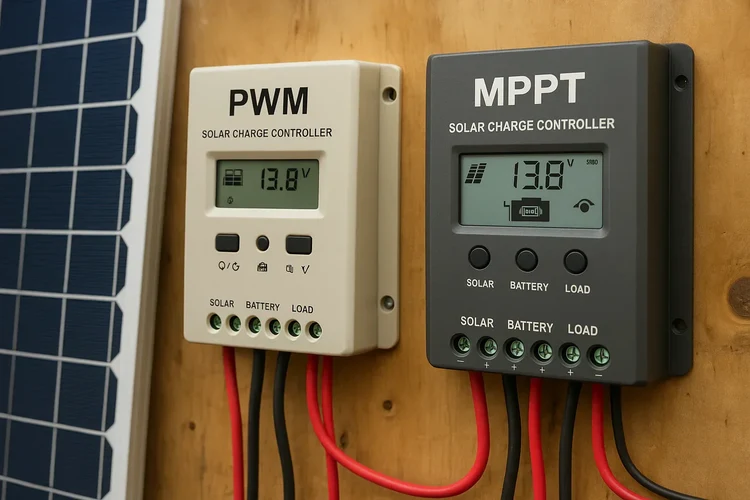
PWM vs MPPT Controllers
Two main types exist. Each fits different setups.
Pulse Width Modulation Controllers:
- Simpler and cheaper
- Work best with small systems
- Less efficient in cooler weather
Maximum Power Point Tracking Controllers:
- More expensive
- Adjust automatically for changing conditions
- Deliver up to 30% more power in some setups
For most boats, MPPT controllers pay for themselves through better efficiency. A qualified marine electrician can help you choose and wire the right controller for your setup.
Common Mistakes Boat Owners Make
Avoid these errors when planning your marine solar system.
Under sizing the System
People slap a single panel on and expect it to cover everything. It almost never does. Run the numbers first.
Ignoring Battery Compatibility
Panels only do half the job. An old lead-acid bank charges slow and holds less than it used to. Upgrading the batteries sometimes helps more than adding another panel would.
Skipping Professional Wiring
Most solar failures on boats trace back to wiring, not panels. Drop connections cause voltage drops, and worse, they start fires. Marine wiring needs marine-rated components. No shortcuts here.
Forgetting Fuse Protection
Solar setups need protection at more than one point. Skip it, and you’re risking the batteries, the panels, and everything wired downstream.
Is Your Boat Actually Ready for This?
Not every boat needs solar today. But a few signs point that way.
- You run the generator daily just to keep the basics on
- Batteries drain fast overnight at anchor
- You’d like mornings without engine noise, for once
- You take longer trips without shore power access
- Your fridge or electronics are already pushing your current setup
Sound familiar? Solar might solve something you’ve been living with for a while now.
Frequently Asked Questions (FAQs)
How Many Solar Panels Does My Boat Actually Need?
Depends entirely on your daily power draw. Work that number out first, then size panels to cover it, plus a 20% cushion for cloudy stretches.
Can Solar Replace My Generator Completely?
For a lot of boats, yes. Smaller and mid-size boats with modest needs often run fine on solar and battery storage alone. Bigger boats running AC will probably still want a generator as backup.
What’s The Best Panel for A Sailboat?
Rigid monocrystalline if you’ve got arch or davit space to mount them. Flexible panels make more sense on a cabin top where flat space is limited.
Do These Panels Still Work When It’s Cloudy?
Yes, but don’t expect much. You’re usually looking at 20% to 50% of normal output under heavy cloud cover.
How Long Do Marine Solar Panels Last?
Rigid panels usually run 20 to 25 years. Flexible panels wear out faster, plan on 5 to 10 years before performance starts dropping.
Can I Install This Myself, Or Do I Need an Electrician?
Small setups, sure, go for it. But once the system grows, or your boat’s wiring gets complicated, a professional installer saves you from mistakes that are expensive to undo later.
When It’s Time to Call a Pro
Marine solar looks simple from the outside. Panels, wires, batteries. But real-world sizing and installation involve more detail.
Wrong sizing wastes money. Poor wiring creates safety risks. Mismatched batteries shorten system life.
Zisser Marine specializes in marine electrical upgrades. Our team calculates your exact power needs, matches the right panels, and wires everything to marine safety standards.
We handle the technical side. You get reliable, quiet power on the water.
Ready to explore solar for your boat? Contact Zisser Marine today for a custom solar assessment.